
Visual Fault Locator Kit (VFL-150)
Ships direct from the manufacturer — please allow up to 10 business days, though it often ships sooner, then goes out via the shipping service you select at checkout. This item does not ship from our warehouse, so delivery times may vary.
Couldn't load pickup availability
Ships direct from the manufacturer. Please allow up to 10 business days, though it often ships sooner.
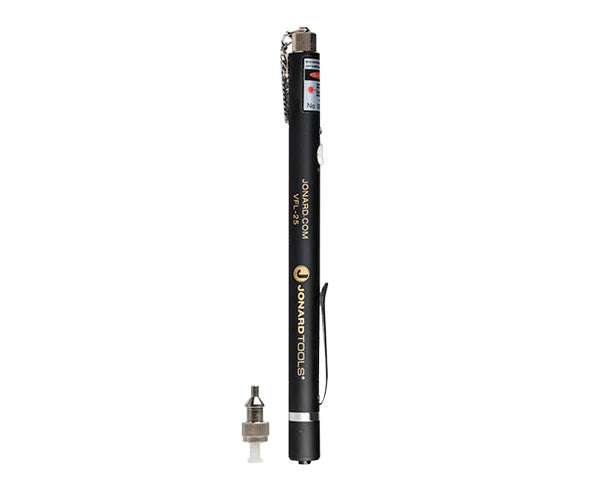
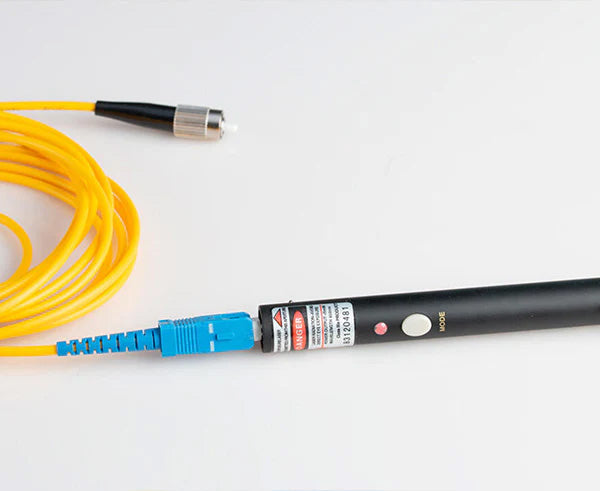
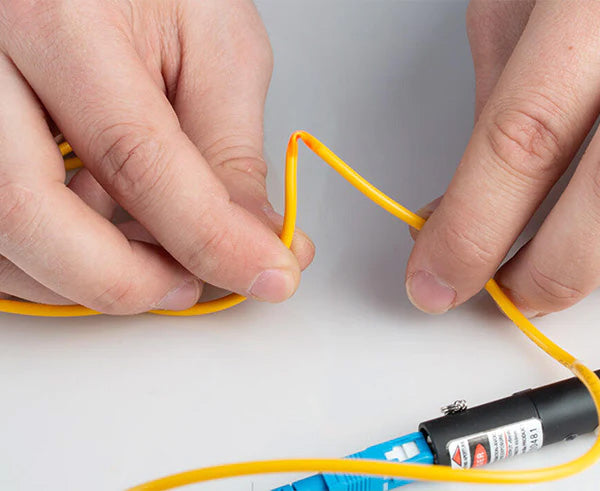
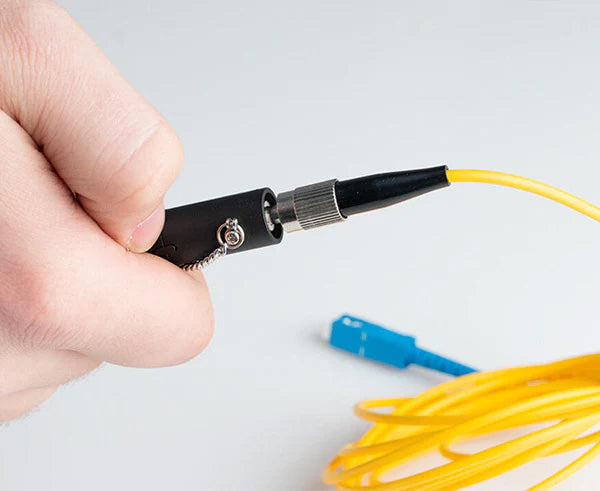
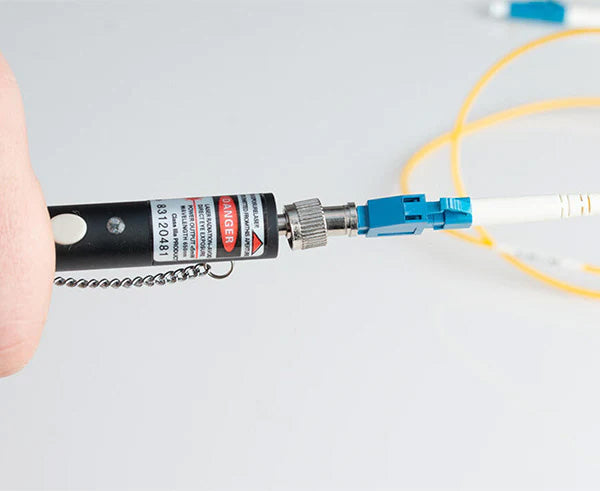
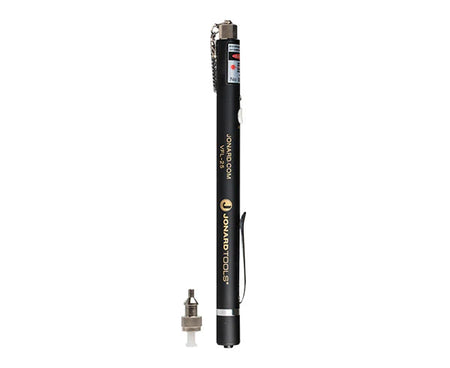
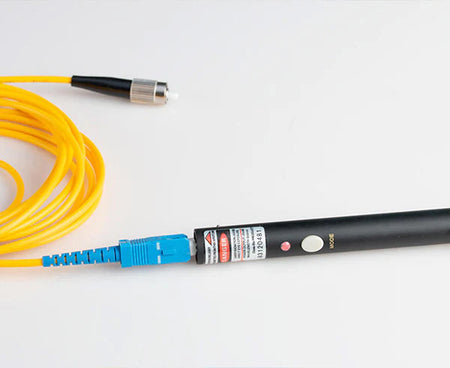
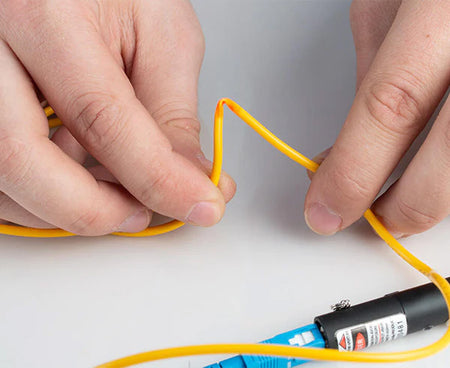
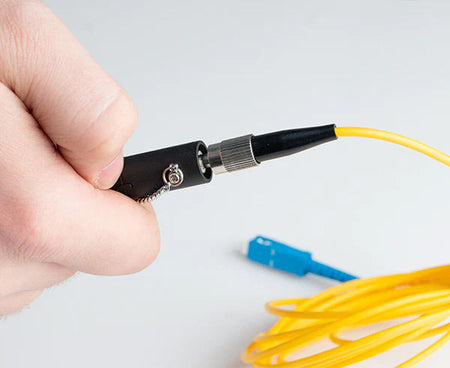
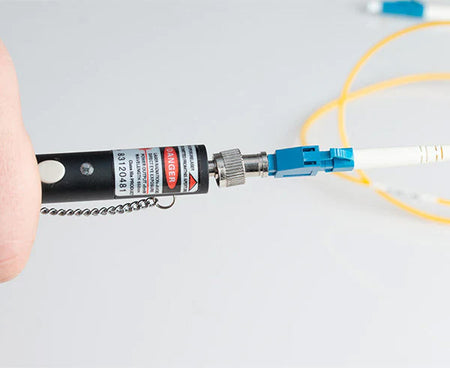
A break, a crushed cable, or a tight bend in a fiber shows up as a glow where the light escapes, and the Jonard Tools VFL-150 is the pen-style visual fault locator kit that puts that light into the fiber. Its 650 nm Class IIIA laser diode finds breakpoints, leaks, poor connections, and stress points in single-mode and multimode fiber up to 5 km (3.1 miles) away, and it works in the dead zone of an OTDR, close to the connector, where an OTDR trace can't resolve a fault. The universal connector takes 2.5 mm ferrule connectors (FC, SC, ST) and an included adapter takes 1.25 mm LC, three output modes (continuous, pulsing, and slow pulsing) make a fault stand out in bright light, and two AAA batteries, included, run it for 60 hours. It's light enough for a shirt pocket, ETL Listed, and the same locator Jonard packs in its TK-161 prep kit.
Features
- 650 nm Class IIIA laser. Visible red light that finds faults in single-mode and multimode fiber up to 5 km.
- FC, SC, ST, and LC. A universal connector for 2.5 mm ferrules and an included VFL-25125 FC to LC adapter for 1.25 mm LC connectors.
- Three modes. Continuous wave, pulsing, and slower pulsing, so a flashing fault stands out from room light and from other sources.
- Works where an OTDR can't. Finds faults in the OTDR dead zone near the connector and does end-to-end visual fiber identification.
- Pen-style and light. Portable design for on-the-go use, at 0.34 lb.
- 60 hours on two AAA batteries. Batteries included.
- ETL Listed. Independently tested to ETL standards.
Where It Fits
It suits FTTH and outside plant technicians tracing a dark drop or finding the break in a cable that failed after a dig, data center and enterprise crews identifying which fiber is which across a panel by lighting one end and looking for the glow at the other, splicing crews checking a splice tray or a closure for a tight bend or a broken fiber before closing it up, installers verifying continuity on a short link that's inside an OTDR's dead zone, anyone who wants a VFL that costs less and weighs less than the rugged VFL-300 and doesn't need its aluminum body and button lock, and the fiber kits it comes in, since the VFL-150 is the fault locator in Jonard's TK-161.
Good to Know
This is a Class IIIA laser. Never look into the output, into a connector, or into the end of a fiber while the locator is on, and never point it at anyone; the beam is visible, which is what makes it useful, and it's strong enough to damage an eye. Use the locator on dark fiber only: disconnect the far end from any equipment before you light the fiber, since the red light into a receiver can damage it, and confirm the fiber is dark before you connect, because connecting a VFL to a live link is a way to get a live laser in the face. Cover or cap the far end if someone else is working at it. The glow shows through the jacket on most indoor and drop cable, which is how a break or a tight bend is found; on armored or heavily jacketed cable the glow only shows at the ends and at a break in the armor, so the locator confirms continuity but can't pinpoint the fault inside. Use the pulse modes in a bright room or when there's other light in the fiber; a flashing glow is easier to spot than a steady one. The 5 km range is for a clean fiber; splices, connectors, and bends each take some of the light, so on a long or lossy run the glow at the far end gets faint before 5 km. The VFL shows where the gross faults are and whether the light gets through; it doesn't measure loss, and a link that lights up end to end can still fail a power meter test. Clean the connector before you plug it into the adapter, since a dirty VFL port contaminates every connector that goes in it afterward. Switch it off and cap it before it goes in a pocket; there's no button lock on this model, and 60 hours of battery goes faster when it's on in a bag.
Specifications
| Spec | Detail |
|---|---|
| Model | VFL-150 |
| Manufacturer | Jonard Tools |
| Type | Visual fault locator kit, pen style |
| Light Source | Class IIIA laser diode |
| Wavelength | 650 nm |
| Distance | Up to 5 km (3.1 miles) |
| Fiber Type | Single-mode and multimode |
| Fiber Connector | FC, SC, ST (2.5 mm universal connector) and LC (1.25 mm adapter, included) |
| Modes | Continuous wave, pulsing, slow pulsing |
| Power | 2 × AAA batteries (included) |
| Battery Life | 60 hours |
| Working Temperature | −20 to 60 °C (−4 to 140 °F) |
| Storage Temperature | −40 to 85 °C (−40 to 185 °F) |
| Compliance | ETL Listed |
| Included | VFL-25 visual fault locator, VFL-25125 FC to LC adapter (1.25 mm), 2 AAA batteries |
| Dimensions | 9 × 2 × 1 in (22.9 × 5.1 × 2.5 cm) |
| Weight | 0.34 lb (154 g) |
| Shipping | Ships direct from the manufacturer, allow up to 10 business days |
Documentation
| Document | Link |
|---|---|
| Data Sheet | VFL-150 data sheet (PDF) |
| Instructions | VFL-150 instructions (PDF) |