
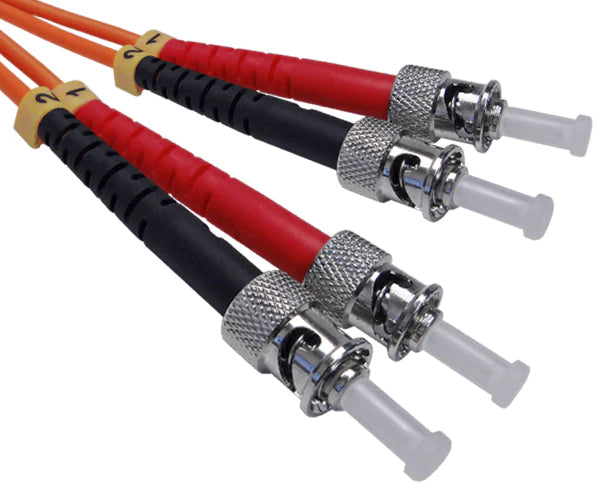
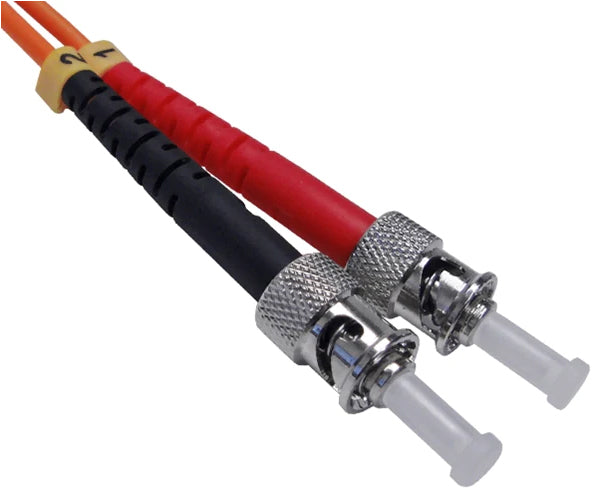
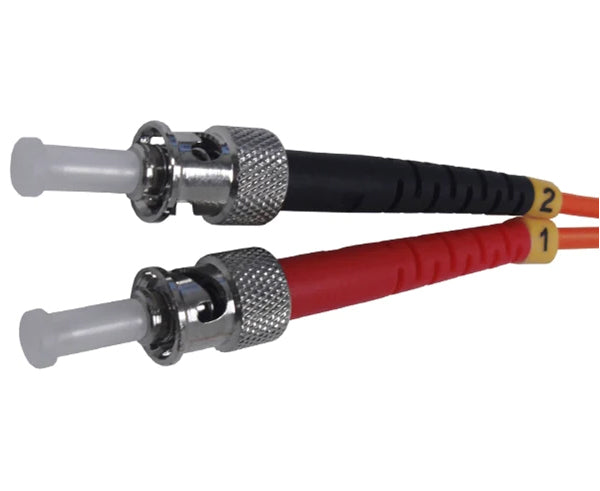
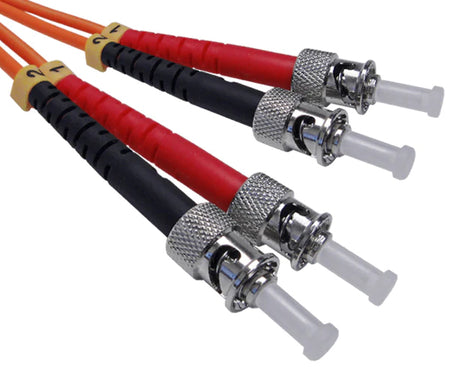
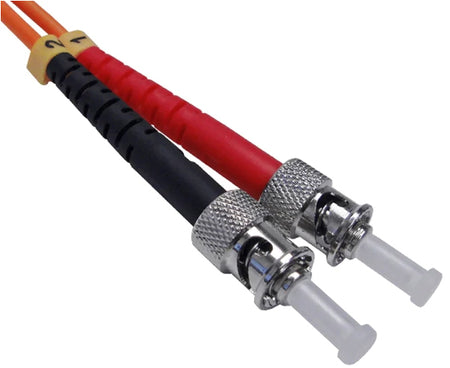
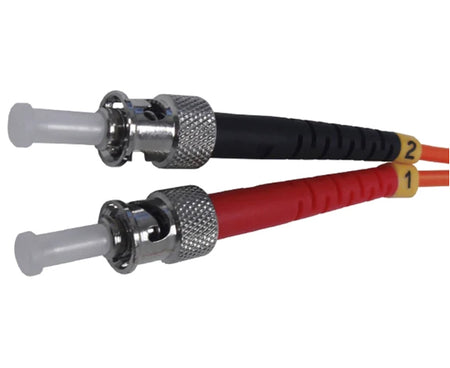
ST to ST Duplex Fiber Optic Patch Cable - Multimode OM1 62.5/125μm
OM1 patch cords are special order. Because OM1 is an older fiber standard, we no longer keep it in stock. These are ordered in specially, minimum quantities may apply, and the item is non-returnable once your order is placed. Contact us for current lead time and minimums.
Couldn't load pickup availability
OM1 is the original multimode fiber, 62.5/125 µm, and ST is the original connector, so this is the cord for the fiber plant that was installed in the 1990s and is still carrying traffic: the orange cable in the ceiling, the ST couplers in the wall-mount enclosure, and the media converters and switch uplinks at each end. It runs 100 Mb/s Ethernet to 2 km and Gigabit to 275 m, which is more than enough for a building backbone, and it's the right cord for patching between ST panels or from an ST panel to an ST port on any of that equipment.
It's a duplex zipcord, two 62.5/125 µm fibers in a 3.0 mm jacket, with ST bayonet connectors on both ends. Each cord is tested and the end-faces are checked by interferometer before it ships.
Features
- ST on both ends. Twist-lock bayonet connectors with PC-polished ferrules, the standard multimode finish.
- OM1 multimode, 62.5/125 µm. Matches the 62.5 µm fiber in older building backbones; 100BASE-FX to 2 km and 1000BASE-SX to 275 m.
- Duplex zipcord. Two fibers in one jacket for a matched transmit and receive pair.
- Low insertion loss. 0.20 dB typical and 0.30 dB maximum per connector.
- 2.5 mm ceramic ferrules, checked by 3D interferometry for end-face geometry.
- Bayonet coupling. Push, quarter-turn, and it's locked; it won't pull out or vibrate loose.
- Orange PVC jacket, 3.0 × 6.1 mm. Heavier 3.0 mm zipcord in the standard OM1 color, for equipment rooms and industrial spaces.
- UL Listed for the US and Canada, and RoHS compliant.
- Five lengths from 1 to 15 m.
Where It Fits
It suits jumpers between ST patch panels and wall-mount enclosures on a 62.5 µm backbone, links from an ST panel to media converters, older switches, and instruments with ST ports, 100 Mb/s and Gigabit uplinks between floors or buildings on existing OM1 fiber, industrial plants and control rooms where a connector that can't shake loose matters, and laboratory and test equipment terminated on ST.
Good to Know
Match the fiber, not just the connector. OM1 is 62.5 µm core; OM2, OM3, and OM4 are 50 µm. Putting a 62.5 µm cord in front of a 50 µm fiber loses several dB at the junction because most of the light lands outside the smaller core, so use this cord only on a plant that's 62.5 µm end to end, which is usually the orange cable and the older install. If your backbone is aqua OM3 or OM4, you want a 50 µm cord. The two ST connectors at each end aren't keyed to each other, so polarity is set by which plug goes into which port: if the link doesn't come up, swap the two ST ends at one side and try again before troubleshooting anything else. To seat an ST, line up the key on the plug with the slot on the port, push in against the spring, and turn clockwise until it stops; a half-seated ST is the most common cause of a "bad" fiber link. Keep dust caps on until the moment you plug in, and clean both the connector and the port with a 2.5 mm one-click cleaner before mating. Gigabit over OM1 tops out at 275 m and 10 Gigabit at about 33 m, so if you're planning an upgrade, the fiber, not the cord, is the limit.
Specifications
| Spec | Detail |
|---|---|
| Series | STSTOM1 |
| Fiber | OM1 multimode, 62.5/125 µm |
| Configuration | Duplex zipcord |
| Connectors | ST/PC to ST/PC, bayonet |
| Ferrule | 2.5 mm ceramic |
| Insertion Loss | ≤ 0.20 dB typical, ≤ 0.30 dB maximum |
| Wavelengths | 850 and 1300 nm |
| Supported Links | 100BASE-FX to 2 km, 1000BASE-SX to 275 m, 10GBASE-SR to 33 m |
| Jacket | Orange PVC, 3.0 × 6.1 mm duplex |
| Color | Orange |
| Lengths | 1, 2, 3, 5, 15 m |
| Compliance | UL Listed (US and Canada), RoHS |