
Riser Rated Unshielded Fire Alarm Cable, 16/4 Solid FPLR, Red - 1000ft
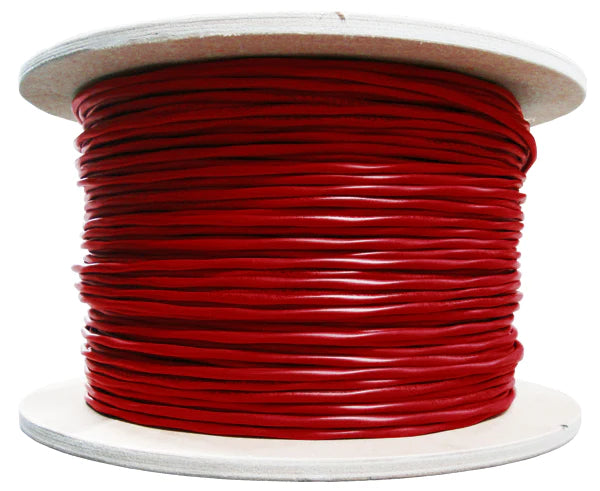
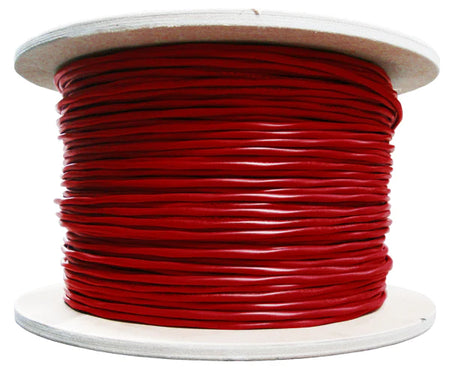
Ships on a wooden spool. These reels are large and heavy, so shipping costs more than a standard parcel and the shipment requires a receiver who can accept and handle it. Confirm your delivery location can accommodate a shipment of this size and weight before placing your order.
Delivery refusal policy. Because of the size and weight of this item, refused deliveries incur significant freight costs. If a shipment is refused or the receiver cannot accept it, you are responsible for both outbound and return freight, plus any restocking fee.
Couldn't load pickup availability
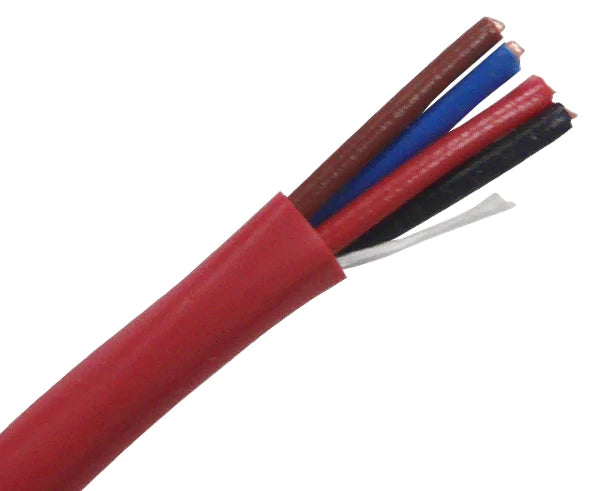
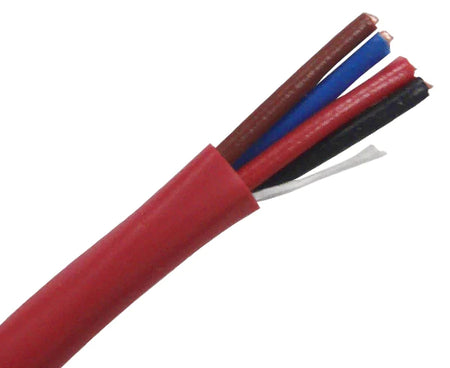
This is the four-conductor riser-rated fire alarm cable in the everyday 16 AWG gauge: four solid bare copper conductors, insulated black, red, brown, and blue in flame-retardant PVC, under a red flame-retardant PVC jacket listed FPLR under NEC Article 760 for power-limited fire alarm circuits. Four conductors means two circuits in one pull: the power pair and the alarm pair for four-wire smoke detectors, a notification circuit and an initiating circuit to the same device box, or a relay module's control and monitor pairs, each on a 16 AWG conductor with about half the loop resistance of 18 AWG, enough for a notification circuit of ordinary length and device count. It's a standard-grade, unshielded cable, which is the everyday construction for notification and initiating circuits on a quiet route.
FPLR covers the vertical runs between floors of a multi-story building and every ordinary in-wall and in-ceiling run that isn't a return-air plenum. The red jacket is the fire alarm identification that inspectors and future technicians expect to see. The cable is RoHS compliant, and it comes on a 1000 ft wooden spool.
Features
- FPLR riser rated. Listed under NEC Article 760 for power-limited fire alarm circuits in riser shafts, vertical runs between floors, and general in-wall and in-ceiling use.
- Four 16 AWG solid bare copper conductors. Two circuits in one cable, each with about half the loop resistance of 18 AWG, for four-wire detectors, combined notification and initiating runs, and control modules.
- Flame-retardant PVC insulation, black, red, brown, and blue. Four distinct colors so each pair keeps its polarity and identity from the panel to the device.
- Red flame-retardant PVC jacket. The standard fire alarm identification, so the cable is recognizable in a tray, a riser, or a junction box years after it's installed.
- Standard grade, unshielded. The everyday construction for notification appliance and initiating device circuits, and the easier one to terminate.
- 300 V, 75 °C. The ratings a power-limited fire alarm circuit calls for.
- 5.11 mm outer diameter. A 0.381 mm jacket wall, sized to fit standard fire alarm fittings and connectors.
- RoHS compliant.
- 1000 ft wooden spool. Put it on a spool stand and it pays out cleanly.
Where It Fits
It suits four-wire smoke and heat detector circuits that need a separate power pair alongside the alarm pair, device runs that carry both a notification circuit and an initiating circuit to the same location, relay and control modules with a control pair and a monitor pair, duct detector and damper control wiring, riser runs between the fire alarm control panel and floor terminal cabinets where two circuits share a route, notification appliance circuits of ordinary length and device count, and any power-limited fire alarm run where two 16 AWG pairs in one pull save a second cable.
Good to Know
Don't put both legs of a Class A loop in the same cable. NFPA 72 requires the outgoing and return conductors of a Class A circuit to be routed separately so that one fault can't take out both, and a four-conductor cable running out and back defeats that; use it for two different circuits, or for the power and alarm pairs of a four-wire device. Run the voltage-drop calculation before you pick a gauge: a 16 AWG pair is about 8 ohms per 1000 ft round trip, so a notification circuit drawing 1.5 A at the far end of a 300 ft run loses about 3.6 V, which is close to the limit most 24 V panels allow; for a longer run or a heavier load, step up to the 14/4. A speaker circuit is figured on impedance and wattage rather than current, using the amplifier manufacturer's tables. FPLR covers risers and general use but not return-air plenums; a run through a plenum ceiling needs FPLP. This is a standard-grade cable, so for an addressable panel's signaling line circuit use the data-grade shielded 16/4, which is built to the tolerances those loops specify and also covers a route that shares a riser or a tray with power, lighting, or elevator wiring. The cable is listed for fire alarm circuits under Article 760, and the AHJ has the final say on using it for anything else, so if it's going on a security, intercom, or control circuit, check first. Keep fire alarm cable separate from power conductors in raceways and boxes, as the code requires for power-limited circuits. Four solid conductors under one jacket make a stiffer cable than a 16/2, so give it a generous bend radius and size the backboxes for it. The PVC jacket isn't UV stabilized or rated for wet locations or burial, so an outdoor device should be fed through conduit or from a cable rated for it.
Specifications
| Spec | Detail |
|---|---|
| Series | FPLRU-164 |
| Type | Power-limited fire alarm cable, riser (FPLR), unshielded, standard grade |
| Conductors | 4 × 16 AWG solid bare copper |
| Conductor Colors | Black, red, brown, blue |
| Insulation | Flame-retardant PVC |
| Shielding | None |
| Jacket | Flame-retardant PVC, red, 0.381 mm (0.015 in) wall |
| Outer Diameter | 5.11 mm (0.201 in) |
| Voltage Rating | 300 V |
| Temperature Rating | 75 °C |
| Packaging | 1000 ft wooden spool |
| Color | Red |
| Compliance | FPLR, NEC Article 760; RoHS |