
LC to LC Uniboot Fiber Patch Cable - 10G OM4 Duplex 50/125μm
Usually ships within 1–3 business days. We ship as soon as possible, though times are not guaranteed, and your order goes out via the shipping service you select at checkout. Please note: patch cords longer than 15 meters may require additional lead time.
Couldn't load pickup availability
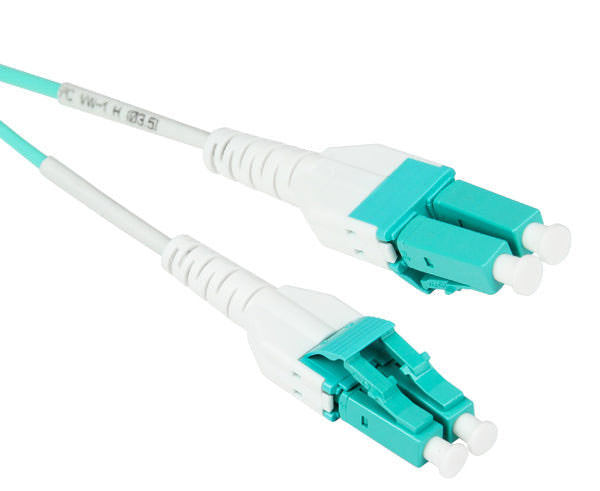
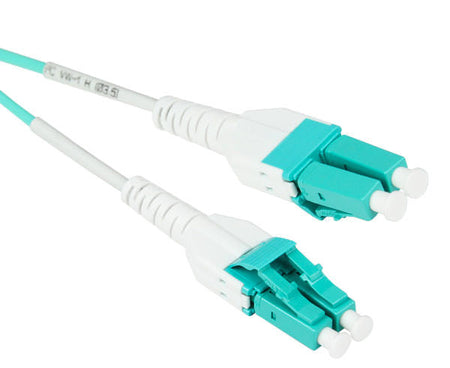
A standard duplex cord is two fibers side by side in a figure-eight jacket. A uniboot cord puts both fibers inside one round 2.0 mm jacket and one boot at each end, so it takes about half the space in a cable manager, blocks less airflow across the front of a switch, and there's only one cable to trace instead of a pair that can split apart. On a 48-port SFP28 line card or a high-density panel, that's the difference between a tidy rack and one you can't see through. This is the OM4 version, on the multimode fiber to buy for anything new: 10GBASE-SR to 400 m, 25 Gigabit to 100 m, and 40G and 100G duplex links to 150 m.
It's OM4 multimode, 50/125 µm, with LC connectors on both ends, wired A-to-B for a transmit and receive pair. Each cord is tested for insertion and return loss and the end-faces are checked by interferometer before it ships.
Features
- Uniboot design. Two fibers in a single 2.0 mm round jacket with one boot per end, for the smallest footprint a duplex LC cord can have.
- OM4 laser-optimized multimode, 50/125 µm. 10GBASE-SR to 400 m, 25GBASE-SR to 100 m, and 40G and 100G duplex links to 150 m.
- LC on both ends. Snap-in connectors with PC-polished ferrules, the standard multimode finish, for SFP+ and SFP28 transceivers, switches, and LC patch panels.
- Low insertion loss. 0.20 dB typical and 0.30 dB maximum per connector.
- 1.25 mm ceramic ferrules, checked by 3D interferometry for end-face geometry.
- A-to-B polarity. Transmit on one end lands on receive at the other, the standard duplex arrangement.
- Flexible strain-relief boots. Built for the moves, adds, and changes a rack jumper goes through.
- Aqua PVC jacket, 2.0 mm round. Fits any LC patch panel and cable manager, and bundles neatly.
- Seven lengths from 1 to 20 m.
Where It Fits
It suits high-density switch line cards and patch panels where a standard zipcord won't fit cleanly, top-of-rack to spine and leaf links at 10G and 25G, 40G and 100G BiDi and SWDM links inside a data hall, blade chassis, SAN, and storage connections, cross-connects in a fiber distribution frame, cold-aisle racks where airflow across the switch face matters, and any multimode link between two LC ports on a 50 µm plant where a smaller, single-jacket cord makes the rack easier to manage.
Good to Know
Match the fiber, not just the connectors. OM4 and OM3 are both 50 µm and mix freely at the distances a patch cord covers, though a link is only as good as its weakest fiber, so an OM4 cord on an OM3 backbone gets OM3 distances. OM1 is 62.5 µm and doesn't mix; on an orange 62.5 µm plant use an OM1 cord instead. 40G and 100G over a duplex LC cord means BiDi or SWDM transceivers; standard 40GBASE-SR4 and 100GBASE-SR4 use MPO cords, not this one. Use multimode SR transceivers; a single-mode LR module won't light a multimode link reliably. Keep dust caps on until the moment you plug in, and clean both the connector and the port with a 1.25 mm one-click cleaner before mating. The round jacket is easy on bend radius, but keep it above about 30 mm under load and don't cinch ties down tight on it. For runs longer than 20 m, the standard LC to LC OM4 cord covers up to 50 m.
Specifications
| Spec | Detail |
|---|---|
| Series | LCLCOM4-UB |
| Fiber | OM4 laser-optimized multimode, 50/125 µm |
| Configuration | Duplex uniboot, A-to-B polarity |
| Connectors | LC/PC to LC/PC |
| Ferrule | 1.25 mm ceramic |
| Insertion Loss | ≤ 0.20 dB typical, ≤ 0.30 dB maximum |
| Wavelengths | 850 and 1300 nm |
| Supported Links | 1000BASE-SX to 550 m, 10GBASE-SR to 400 m, 25GBASE-SR to 100 m, 40G and 100G BiDi/SWDM to 150 m |
| Jacket | Aqua PVC, 2.0 mm round |
| Color | Aqua |
| Lengths | 1, 2, 3, 5, 10, 15, 20 m |
| Testing | Insertion and return loss tested, interferometer inspected |