
Riser Rated Unshielded Fire Alarm Cable, 14/2 Solid FPLR - 1000ft
Ships on a wooden spool. These reels are large and heavy, so shipping costs more than a standard parcel and the shipment requires a receiver who can accept and handle it. Confirm your delivery location can accommodate a shipment of this size and weight before placing your order.
Delivery refusal policy. Because of the size and weight of this item, refused deliveries incur significant freight costs. If a shipment is refused or the receiver cannot accept it, you are responsible for both outbound and return freight, plus any restocking fee.
Couldn't load pickup availability
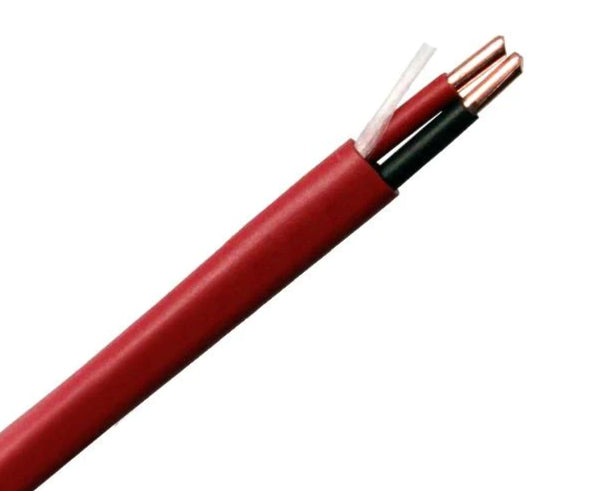
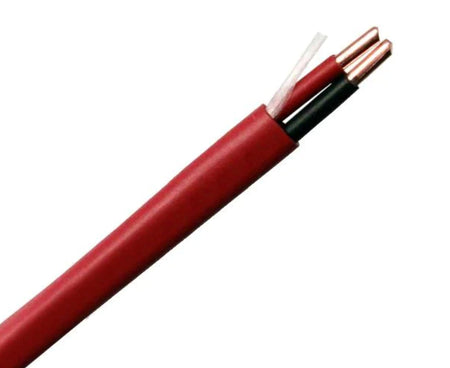
This is the standard-grade riser-rated fire alarm cable in the heavier 14 AWG gauge: two solid bare copper conductors, insulated black and red in PVC, under a red PVC jacket listed FPLR under NEC Article 760 for power-limited fire alarm circuits. Standard grade means it's built for notification and initiating circuits, where the electrical tolerances of a data-grade cable aren't needed, and priced accordingly. FPLR covers the vertical runs between floors of a multi-story building and every ordinary in-wall and in-ceiling run that isn't a return-air plenum, which makes it the everyday cable for notification appliance circuits, initiating device circuits, and the panel-to-device wiring of a fire alarm system. The red jacket is the fire alarm identification that inspectors and future technicians expect to see, and the black and red conductors carry the polarity marking that a supervised notification circuit depends on.
14 AWG has about 60% of the loop resistance of 16 AWG, which is the step up for a notification appliance circuit or voice evacuation speaker run that's a little too long or a little too loaded for 16 AWG but doesn't need the bulk of 12. It comes on a 1000 ft wooden spool.
Features
- FPLR riser rated. Listed under NEC Article 760 for power-limited fire alarm circuits in riser shafts, vertical runs between floors, and general in-wall and in-ceiling use.
- 14 AWG solid bare copper conductors. About 60% of the loop resistance of 16 AWG, for notification and speaker circuits that have outgrown 16 without the stiffness of 12.
- PVC insulation, black and red. Color-coded conductors for polarity on notification and initiating circuits.
- Red PVC jacket. The standard fire alarm identification, so the cable is recognizable in a tray, a riser, or a junction box years after it's installed.
- Standard grade, unshielded. The everyday construction for notification appliance and initiating device circuits; for an addressable signaling line circuit, use a data-grade cable.
- Rip cord under the jacket. Pull it back to open the jacket cleanly at a device or a terminal cabinet, with no blade near the conductor insulation.
- 300 V, 75 °C. The ratings a power-limited fire alarm circuit calls for.
- 5.41 mm outer diameter. A 0.381 mm jacket wall, sized to fit standard fire alarm fittings and connectors.
- 1000 ft wooden spool. Put it on a spool stand and it pays out cleanly.
Where It Fits
It suits notification appliance circuits with a moderate-to-high count of horns and strobes, voice evacuation speaker circuits from the amplifier to the last speaker on a floor, initiating device circuits to smoke detectors, heat detectors, pull stations, and waterflow switches, panel-to-annunciator and panel-to-relay wiring, riser runs between the fire alarm control panel and floor terminal cabinets in apartment buildings, hotels, schools, and offices, and any power-limited fire alarm run where 16 AWG comes up short on voltage drop.
Good to Know
Run the voltage-drop calculation before you pick a gauge. A 14 AWG pair is about 5 ohms per 1000 ft round trip, so a notification circuit drawing 1.5 A at the far end of a 300 ft run loses about 2.3 V, comfortably inside what most 24 V panels allow, and a 2 A load at 400 ft loses about 4 V; past that, step up to 12 AWG. A speaker circuit is figured on impedance and wattage rather than current, using the amplifier manufacturer's tables. FPLR covers risers and general use but not return-air plenums; a run through a plenum ceiling needs FPLP. The cable is listed for fire alarm circuits under Article 760, and the AHJ has the final say on using it for anything else, so if it's going on a security, intercom, or control circuit, check first. Keep fire alarm cable separate from power conductors in raceways and boxes, as the code requires for power-limited circuits, and use the red jacket to keep it separate from the rest of the low-voltage wiring in a tray. This is a standard-grade cable, so for an addressable panel's signaling line circuit use the data-grade shielded 14/2, which is built to the tolerances those loops specify and also covers a noisy route with a foil shield and drain wire. 14 AWG solid is stiffer than 16, so give it a generous bend radius and use device terminals rated for it. Use the rip cord to strip the jacket rather than a knife; a nick in a 14 AWG conductor's insulation is the kind of fault a supervised circuit finds months later. The PVC jacket isn't UV stabilized or rated for wet locations or burial, so an outdoor device should be fed through conduit or from a cable rated for it.
Specifications
| Spec | Detail |
|---|---|
| Series | FPLRU-142 |
| Type | Power-limited fire alarm cable, riser (FPLR), standard grade |
| Conductors | 2 × 14 AWG solid bare copper |
| Conductor Colors | Black, red |
| Insulation | PVC |
| Shielding | None |
| Jacket | PVC, red, 0.381 mm wall, with rip cord |
| Outer Diameter | 5.41 mm (0.213 in) |
| Voltage Rating | 300 V |
| Temperature Rating | 75 °C |
| Packaging | 1000 ft wooden spool |
| Color | Red |
| Compliance | FPLR, NEC Article 760 |